
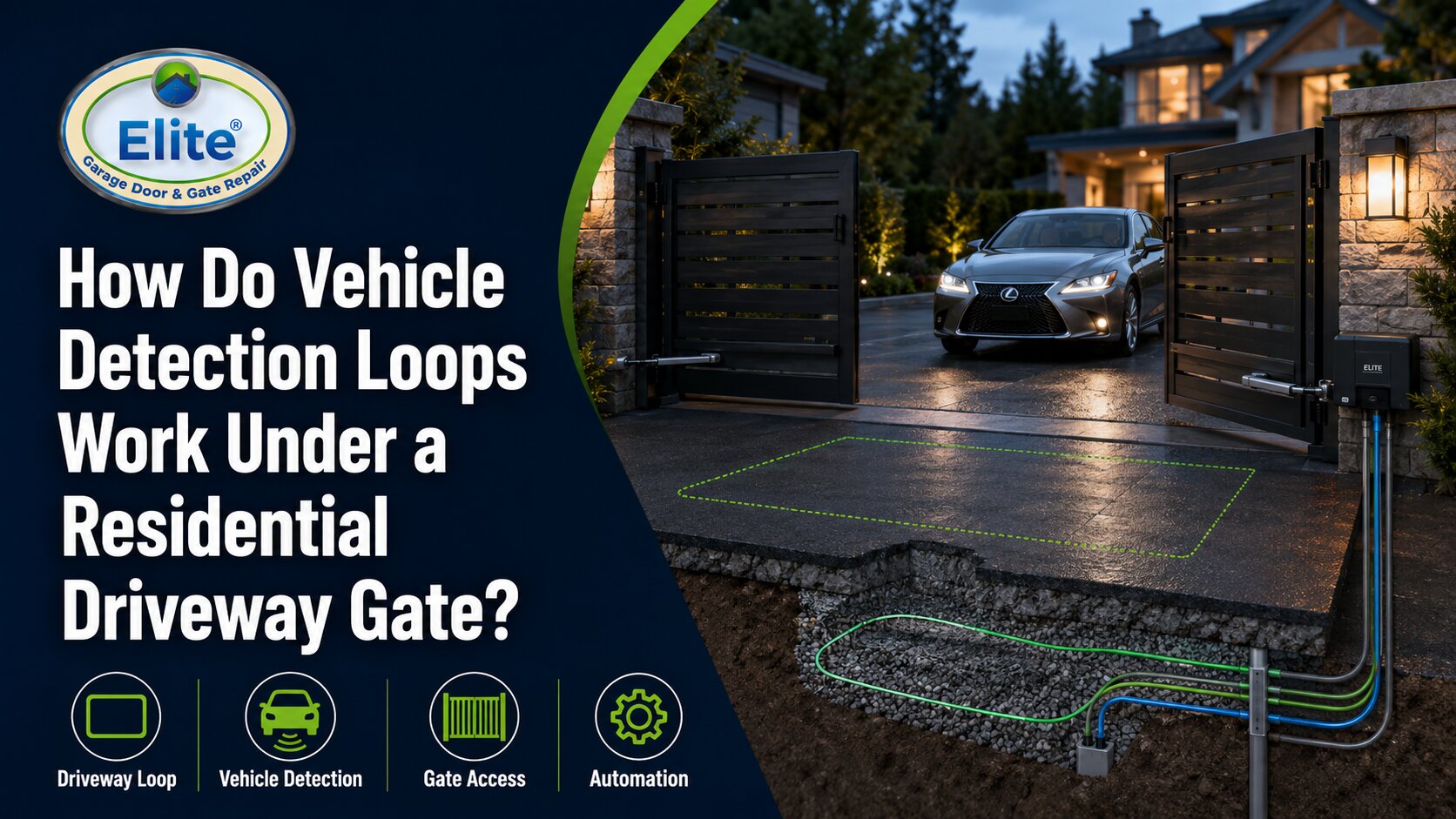
Vehicle detection loops are embedded wire sensors installed beneath the pavement of your driveway that sense the presence of a car and trigger your automated gate to open or close. The system works through electromagnetic induction: a loop of wire is placed in a shallow groove cut into the asphalt or concrete, connected to a loop detector controller. When a vehicle passes over or stops on the loop, the metal in the car disrupts the electromagnetic field, sending a signal to the gate operator to activate.
This technology is widely used in residential gate automation across Seattle, particularly in hilly neighborhoods like Queen Anne and Magnolia where driveways often require hands-free access.
The loop itself is typically a continuous wire circuit, often two to four turns of insulated wire laid in a rectangular or circular pattern. Once installed, the groove is sealed with flexible rubberized filler or epoxy to protect the wire from moisture and freeze-thaw cycles common in the Pacific Northwest. The detector monitors the inductance of the loop constantly, and any change caused by a metal object triggers the gate mechanism.
This makes loops highly reliable for residential applications, especially when paired with quality gate openers and modern automation systems like those available through our Door Designer.
Installation begins with cutting a narrow slot, usually about one and a half inches deep and one-quarter inch wide, into the driveway surface in the desired loop shape. Professional installers use a concrete saw or asphalt cutter to create clean edges that minimize surface disruption. The wire is then laid into the slot, typically using 18 to 20 gauge wire rated for burial and outdoor exposure.
Elite Garage Door & Gate Repair of Seattle (WA License #ELITEGD8339J) often installs these loops for clients throughout King County, customizing the loop size and placement based on driveway width, slope, and gate swing radius.
After the wire is seated, the slot is filled with a sealant that bonds to the surrounding pavement and remains flexible in wet conditions. This step is crucial in the Seattle climate, where constant rain and temperature swings can cause rigid fillers to crack and expose the wire. The wire ends are then routed underground in conduit to the gate operator control box, where they connect to the loop detector module.
Proper installation ensures the loop withstands vehicle traffic, weather, and settling over time without losing sensitivity.
Configuring Loop Sensitivity and Functionality for Residential Gates
Once installed, the loop detector must be calibrated to respond appropriately to vehicles without false triggers from bicycles, pets, or pedestrians. Most modern loop detectors offer adjustable sensitivity settings, allowing you to fine-tune the system based on vehicle type and driveway conditions. For sloped driveways common in neighborhoods like Capitol Hill and Beacon Hill, loop placement and sensitivity become even more important to ensure consistent detection as vehicles approach at varying speeds and angles.
Loops can be configured for different functions depending on your gate automation needs. A free exit loop placed on the interior side of the gate allows vehicles to leave without using a remote or keypad. A safety loop positioned in the gate’s path prevents the gate from closing on a vehicle, acting as a critical safety feature.
An entry loop on the exterior can trigger the gate to open automatically for arriving vehicles, though this is less common in residential settings due to security concerns. Elite Garage Door & Gate Repair of Seattle can help determine the best loop configuration for your property, balancing convenience, safety, and security.
Common Loop Detection Issues in the Pacific Northwest
Seattle’s wet climate and hilly terrain can introduce unique challenges for vehicle detection loops. Moisture infiltration through cracked sealant is one of the most common causes of loop failure, leading to short circuits or signal degradation. Driveway settling or movement, especially on properties near Lake Washington or the Cascade foothills, can stress and break wires over time.
Tree roots, freeze-thaw cycles, and heavy vehicle traffic can also compromise loop integrity.
In some cases, wireless vehicle sensors or photo-eye systems may offer a viable alternative if loop repairs become impractical, similar to how you might need to know How Do I Manually Open My Garage Door During A Seattle Power Outage? for backup access solutions.
Professional Vehicle Loop Installation and Repair in Seattle, WA
While some homeowners attempt DIY loop installation, professional service ensures proper wire selection, burial depth, sealing, and calibration for long-term reliability. Incorrect installation can result in weak detection, frequent false triggers, or premature loop failure that requires costly re-cutting and reinstallation. Experienced technicians also account for local conditions like drainage patterns, pavement composition, and electrical interference from nearby utilities.
If you’re considering adding vehicle detection loops to your residential gate system or need repair service for an existing loop, Elite Garage Door & Gate Repair of Seattle offers expert installation and diagnostics throughout the greater Seattle area. Our licensed team understands the specific challenges of Pacific Northwest climates and terrain. Visit us online at elitegaragewa.us or call (206) 934-1234 to schedule a consultation and ensure your automated gate system operates safely and reliably for years to come.